Khodorkovsky exclusively for ‘Vijesti’: The Balkans remains a space for a Russian geopolitical experiment
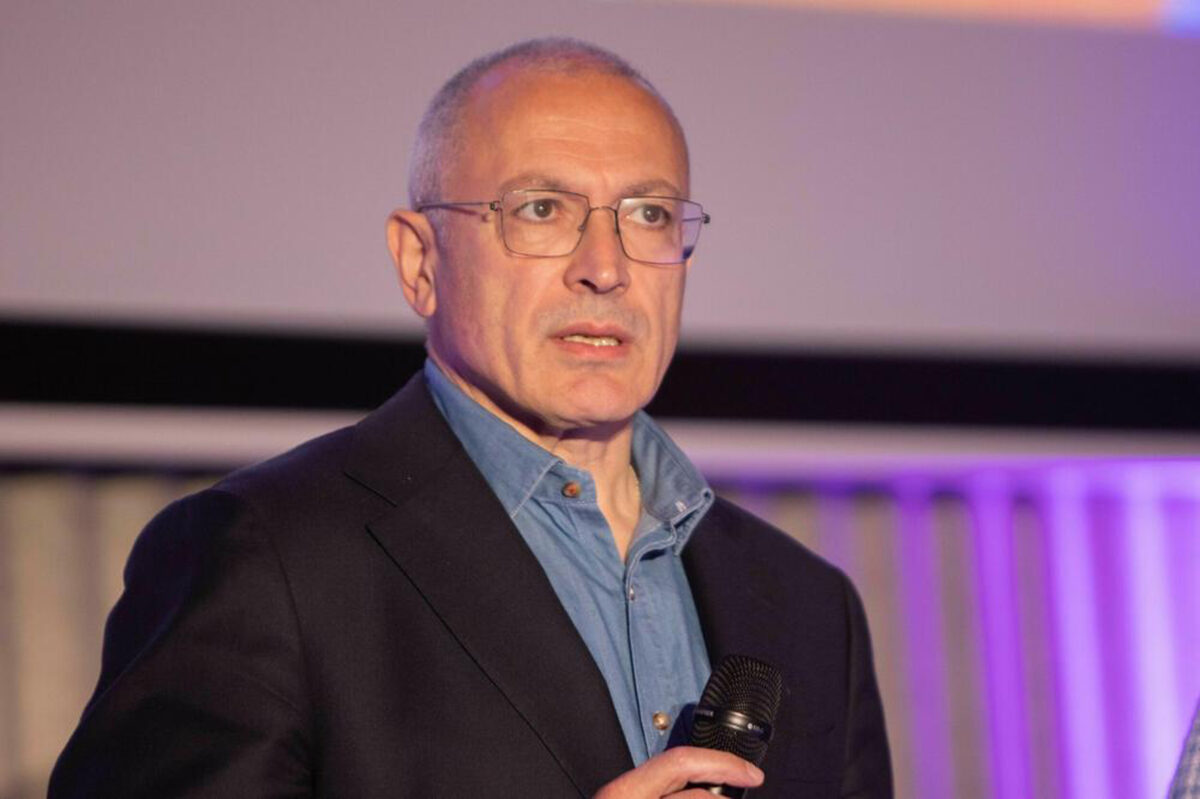
From Russia’s richest man to a political prisoner – one of Vladimir Putin’s most famous critics analyses the Kremlin’s strategy towards Montenegro, the EU and the region, for Vijesti, and speaks about the hybrid, yet new Cold War in Europe.
Once Russia’s richest man, a symbol of the wild post-Soviet privatisation and oligarchic capitalism, he is today one of Vladimir Putin’s most vocal and consistent opponents. Mikhail Khodorkovsky is the man whose fate the Kremlin turned into a political message: anyone who dares to challenge the system will be broken. The founder of the oil giant Yukos, who in the early 2000s spoke openly about corruption at the top of the state and financed the opposition, spent almost ten years in Russian prisons in trials that were deemed politically motivated by international organisations and Western governments. After his pardon in 2013 and going into exile, Khodorkovsky has neither illusions nor interest in the Russian system, except to expose it.
From the position of an insider who knew Putin’s Russia from its very core of power, but also from the experience of a political prisoner, Khodorkovsky today speaks openly from his London exile about the mechanisms by which the Kremlin destabilises other states: from propaganda and hybrid warfare, to the manipulation of local weaknesses and social divisions. For him, nuclear weapons are not the most dangerous instrument of Putin’s power, but propaganda is. In an exclusive interview with “Vijesti”, Khodorkovsky speaks frankly and without diplomatic gloves about the Balkans as a region that Moscow still regards as its sphere of interest, about Montenegro as a target of more subtle, yet long-term, pressure, and about Europe, which, in his view, has not yet realised that the time for strategic naivety is over.
This is not an interview with a geopolitics’ theorist, but with a man who paid a heavy price for his personal experience with the system he speaks of, and who today warns that the same patterns – just adapted to local contexts – are already being tested on the periphery of Europe.
The Kremlin’s Strategy and Montenegro
How would you describe the Kremlin’s strategy towards Montenegro today, after two decades of political, propaganda and intelligence activity in the country?
At this point, the Kremlin is focusing its efforts in the Balkans on countries neighbouring Montenegro: Serbia and the Republika Srpska within Bosnia and Herzegovina. But that does not mean that Montenegro is safe. The Kremlin sees the Balkans and the countries of the former Soviet bloc as its spheres of influence and directs its instruments of hybrid warfare at them.
Does Russia still see Montenegro as a space in which it can regain influence, despite its membership of NATO?
Russia considers itself to be in a state of undeclared war with NATO, so although NATO membership protects Montenegro from the most brutal forms of Kremlin action, the drive to restore its sphere of influence remains.
EU officials are warning of ‘very active Russian propaganda’ in Montenegro. How much more dangerous is the Kremlin’s propaganda apparatus today compared to the period when you were in Russia?
Propaganda is the Kremlin’s main and most effective weapon. If you ask me what is more dangerous in Putin’s hands, nuclear weapons or propaganda, I will say, of course, propaganda, because it will be propaganda that will be the trigger for the use of nuclear weapons. Putin’s propaganda works better than Soviet propaganda. Soviet propaganda tried to glorify communism. Putin’s is aimed at creating chaos, contradictions and discontent. His propaganda doesn’t tell you how good things are in Russia, because that can be easily checked and seen not to be the case. But it very skilfully finds the sore spots in your country and presses them. Migration, poverty, insecurity, dissatisfaction with life—these things exist everywhere. Putin very skilfully exploits these problems and stokes people’s discontent. This is the strength and threat of his propaganda outside of Russia.
In your opinion, what is the most effective way for a small country like Montenegro to protect itself from Russian hybrid operations?
Russia’s strategy for conducting hybrid operations always relies on the local population. There is a large Russian diaspora in Montenegro, and there is knowledge of and respect for Russian culture in the country. It is very important to form a considered and well-intentioned policy towards people of Russian origin living in Montenegro. These people should be turned into allies, and then the Kremlin will have far fewer opportunities for hybrid warfare and propaganda in Montenegro. Such a policy can be built, for example, by supporting Russian anti-war culture, one of the centres of which is, in fact, Montenegro.
How justified are the fears that Russian propaganda could influence the outcome of possible referendums in EU member states on Montenegro’s accession?
Putin’s propaganda is aimed at dividing peoples and destroying European institutions, so it would be no surprise if the Kremlin were to continue the same policy in this case as well.
Do you believe that Russia is actively trying to slow down or compromise Montenegro’s path to EU membership?
Yes, of course. Putin thinks in the categories of a bipolar world and a zero-sum game. Everything his opponents lose seems like a gain to him. He perceives the accession of an increasing number of countries to the EU, especially from the former Eastern Bloc, as a defeat. And the Kremlin is doing everything it can to prevent this.
How would you characterise the current relationship of Montenegrin society towards Russia: rational, nostalgic or vulnerable?
I’m afraid I’m not sufficiently familiar with the situation to make judgements about Montenegrin society.
What role do you see for the Montenegrin media in countering disinformation, given your experience with Putin’s propaganda system?
Your media have great potential in this regard. Firstly, you understand the Russian mentality quite well. Historically, we are closer to each other than to many other Western European countries. Secondly, you have excellent expertise among Russian opposition journalists, artists, and writers. For example, there is the cluster that Marat Gelman has brought together in Budva. These people can be of great help to Montenegro in the fight against the dangerous influence of Putin and his propaganda.
Regional context and security risks
To what extent does the Balkans fit into Putin’s logic of using crises to resolve domestic problems – as a potential new flashpoint of instability?
Putin’s entire strategy is based on creating chaos and conflict around the world, and then offering himself as the solution to the problem. In doing so, he could not care less what happens to the countries and people he has exploited to create such situations. Look at Syria, it’s a good example of Putin’s approach and his attitude towards those he calls allies.
How likely is it that Russia, relying on a large corps of veterans and parallel structures, could direct destabilisation towards regions with weak institutions, such as the Western Balkans?
While Putin is preoccupied with the war in Ukraine, that is not particularly likely. But from the moment the current war ends, he will have two to three years before he realises he can no longer govern the country without a war. Where will he then direct his forces? I would have thought of the Baltic first, but the Balkans should not be ruled out either.
If the war in Ukraine becomes a frozen conflict, does the risk increase that the Kremlin will seek new targets in areas without a direct military presence of NATO?
For domestic political reasons, Putin can no longer do without war. After the war with Ukraine ends, he will look for new targets. I don’t think this will immediately be a direct invasion of NATO countries. I would expect constant hybrid provocations and sabotage instead. But these could very likely escalate into a full-scale war, especially if he assesses that Europe is not ready.
Putin, Trump and the Logic of Power
You often say that Trump and Putin operate like ‘two gangsters’. What exactly do you mean by that, and how does their style of negotiation differ from Western political standards?
Trump’s negotiating style is more like that of a New York property developer who has experience with both semi-criminal unions and tough partners. It is characterised by two key things. First, Trump does not attach much importance to ideological values. He is focused on achieving a tangible result and direct benefit: signing a contract, a deal, or something similar. Second, he does not place much importance on words. If it is necessary for him to achieve his goal—to intimidate, surprise or confuse his interlocutor—of saying something stupid or an obvious untruth, he will say it. And he will not worry in the slightest when the time comes to disown those words.
Putin’s approach is purely bandit-like. He lies, manipulates, and sees politeness as a sign of weakness. He only stops when he meets another’s force. He is very brutal in his words, but in reality, he has no desire to put his personal safety at any risk.
Why, in your opinion, do Europeans continue to misinterpret the messages coming from the White House and the Kremlin?
I don’t think European politicians don’t understand the signals from Washington and Moscow. They are not stupid people. The problem is that Europe has no adequate response.
Putin is saying openly: I am prepared to wage war for a while longer and I am prepared to increase the military threat to Europe to achieve my objectives.
Trump says: since Putin is threatening Europe, not America, the US does not consider it their problem and wants to focus on China.
Europe’s response should have been heard four years ago. Europe had to realise that it could only guarantee its own security. It should then have sharply increased its defence spending and military production. It should have started preparing its people for the possibility that they might have to defend their freedom. But that did not happen.
During the post-Cold War period, Europe built welfare states. This is expensive, and there is little room left in budgets for military spending. European politicians fear that if they cut social, pension or healthcare benefits to increase military spending, they will lose power. Although they actually lack the leadership and ability to boost the economy so that there is room for both.
This is why Europe is still trying to prevent Trump from abandoning the burden of European security in the face of Putin’s threats.
You claim that for both Putin and Trump, words are merely tactics, not commitments or intentions. How, then, can their actions be assessed?
Trump wants an end to the war. It really matters to him. But he isn’t particularly concerned about the conditions under which it happens. Whether it will be a just or a shameful peace is of no consequence to him, because his voters have no demand for any specific form of peace agreement. The voter thinks like this: has the shooting stopped somewhere in Eastern Europe? Excellent. And the average person in the American Midwest couldn’t care less exactly who got Donbas. That’s why Trump behaves the way he does.
Putin, on the other hand, believes he has the upper hand and is trying to maximise it. Trump has offered him very favourable terms (harsh and humiliating for Ukraine). But Putin is in no hurry to agree even then, stalling in an attempt to get even more. The price of this stalling is tens of thousands of lives on both sides of the front line.
What does this logic of transactional power mean for small states like Montenegro?
It’s all quite simple. Montenegro cannot measure up to the US, China, the EU, India or Russia in terms of economy, population or military. You have to think about creating competitive advantages that will compel the great powers and blocs to take you into account.
In the context of Europe and the end of the war, you have certain prerequisites for that. For example, due to your geographical location, history, climate and visa policy, you have a large Russian diaspora. It will not disappear after the war ends. And a lot depends on your policy towards that diaspora.
Montenegro is on the verge of EU membership. This, of course, means a tightening of visa policy, which will inevitably affect all diasporas, including the Russian one. I would suggest considering how to soften this transition. The loyal, peace-oriented and culturally and politically influential Russian diaspora is, in fact, a competitive advantage for Montenegro under conditions of transactional politics.
Could any future agreement between Moscow and Washington – regardless of its form – affect the geopolitical position of Montenegro and the region?
I don’t think there will be a direct impact. But a future agreement will, without a doubt, consolidate the return to bloc thinking and the categories of spheres of influence. Montenegro will be put in a position where it needs to choose a bloc to align itself with. It is better to make that choice voluntarily, in favour of the EU, than under pressure and in the direction of today’s totalitarian Kremlin.
Ukraine, Russia and the long-term consequences
Why do you think President Zelenskyy misunderstood the key European message that Europe cannot provide sufficient support for Ukraine without the United States?
President Zelenskyy is not a stupid man. He perfectly understands all the European messages. And what choice does he have? He is trying to preserve American support and is working a lot with Trump’s team. But if America withdraws from the conflict, Europe remains Ukraine’s only partner. That is why Zelenskyy’s aim is, under all circumstances, to prevent Europe from weakening its support. This is why, out of necessity, he reacts to statements that Europe cannot sustain such support without US involvement.
To what extent are the Ukrainian leadership and society misjudging the political reality in Washington?
Ukraine perfectly understands the mood in the White House. After the argument in the Oval Office, Zelenskyy’s team drew the right conclusions and adjusted their approaches. The problem is that Zelenskyy is playing the hand he’s been dealt. He faces many constraints and doesn’t have much freedom of manoeuvre.
Why do you claim that Putin “hasn’t lost” in Ukraine and what outcome do you see as the most realistic?
After Putin failed to defeat Ukraine in three days in 2022, I thought he had made a fatal mistake. There were at least two realistic opportunities for him to lose power because of the invasion.
The first opportunity was in the hands of Biden and Europe. If, in 2022, they had given Ukraine all the weapons they have provided to date (missiles, aircraft, air defence systems, and so on), along with closing the skies over Ukraine, Putin would have lost the war. And had he lost the war, his regime would not have survived.
The second opportunity was in 2023. Had Prigozhin’s rebellion lasted a few more days, generals would have joined it. In that situation, there would have been a possibility of overthrowing Putin’s regime. And, more importantly, it would have opened up space for the democratic opposition.
Both opportunities were missed. As a result, Putin not only retained power but also strengthened it. He faces a number of problems: the economy, demographics, technological lag, and dependence on China, but these do not pose a serious threat to him over the next two to three years.
Putin will succeed in selling the end of the war to Russian society as his victory. As a result, he will retain power and face no serious political challenges. The price of this will be major structural problems that will lead the country into slow but steady decline. These problems will not threaten the regime in the next three to five years, but will return later in the form of serious crises.
Europe, for its part, faces a new Cold War. The choice in the coming years will be: either to preserve sovereignty, or to attempt to preserve all the achievements of the welfare state at the cost of some sovereignty. I fear that the short-term choice will be the wrong one.
Why do most Russians still support Putin despite everything, and what would have to happen for him to lose that support?
For a start, nobody knows how many Russians actually support Putin. How can you verify that? There are no fair and free elections, and poll results do not reflect the true picture. Russians support Putin not because of anything he does. If you look at the poll results, 60 per cent of Russians will support Putin if he ends the war. And that same 60 per cent will support him if the war continues. What does that mean? That under a totalitarian dictatorship, it is inherent for citizens to agree with the authorities on everything. It’s simply safer that way. It’s a form of Stockholm syndrome, when hostages develop sympathy for their captors. It’s a psychological mechanism of adaptation and survival. But that doesn’t mean that Russians love Putin.
The interview was conducted by Nina Vujačić and was originally published in the Vijesti