When facing Putin, you must first show strength, then negotiate
For Mikhail Khodorkovsky, the signs of the Russian regime’s decline are multiplying. But without a show of European strength, the Kremlin will continue to test the continent’s limits.
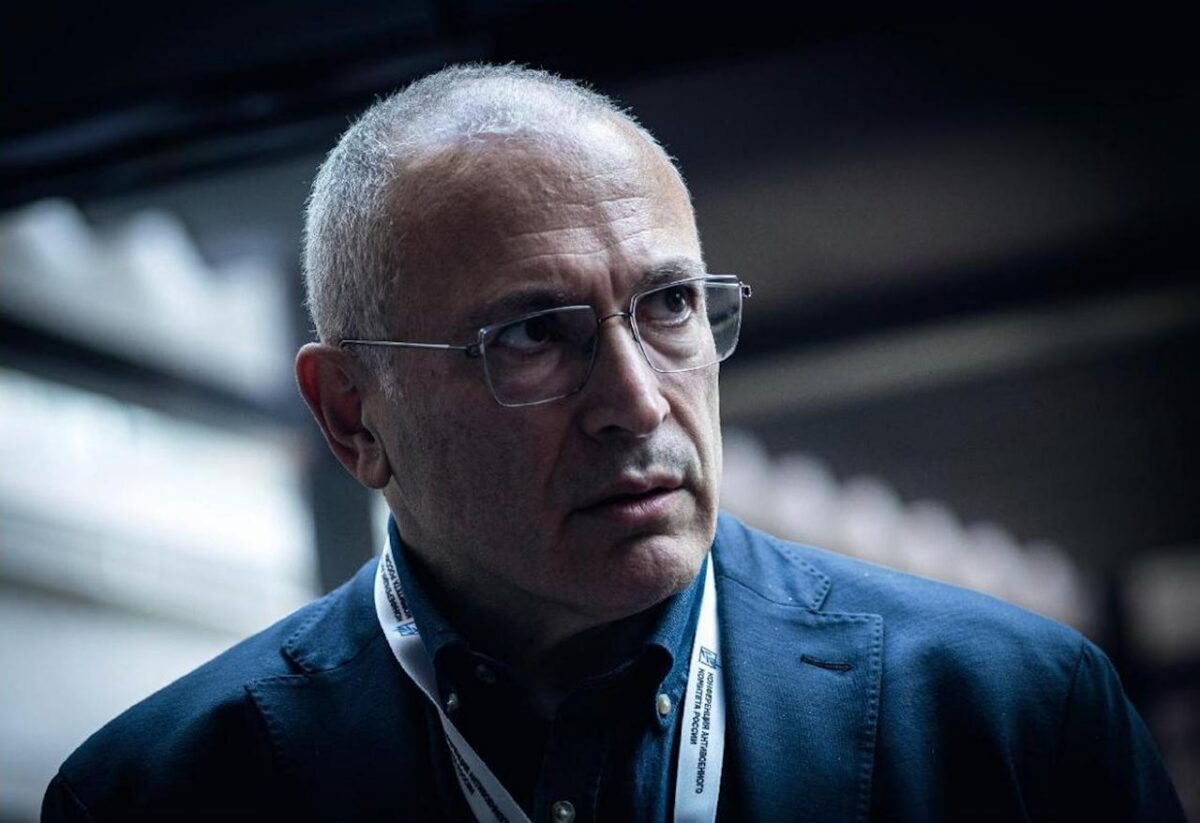
After founding Open Russia in 2001, the man who was then Russia’s richest businessman saw his Yukos oil company seized, largely resold to Rosneft, and subsequently dismantled. A former political prisoner in Russia, Mikhail Khodorkovsky is today the most active opponent of Putin. Living in exile in London since 2013, he deplores Western naivety regarding the Russian regime.
More than four years after the invasion of Ukraine, Vladimir Putin has recently hinted that the war is drawing to a close. Is this a trap, or does it reflect a weakening of Russia?
Putin wants to obtain the best possible peace conditions while Donald Trump is in power, and Trump, in exchange for stopping the war, has offered him reintegration into the international community. Putin knows that no one else will make him such an offer. He initially refused it, but now seems ready to accept it.
At the same time, there is also the fact that Ukraine has not only resisted winter strikes against its infrastructure—particularly those targeting heating systems—but Kyiv has also succeeded in stopping the Russian offensive at the beginning of spring.
This change of position is all the more significant because it is accompanied by another development. At the beginning of the year, Putin asserted that there was no point in talking to anyone other than the United States, meaning neither Ukraine nor Europe. Now, he no longer mentions Trump and speaks of the need to dialogue with Ukraine, implying that this must also be done with Europe. Even if the situation is not yet critical for the regime, serious vulnerabilities are appearing.
* You knew Vladimir Putin well. How do you analyse his psychological and emotional state?
During his speeches at the May 9 commemorations, I noticed very visible changes in the way he speaks and in the stylistics of his delivery.
In the past, he has had speech impediments, but that used to look like the behaviour of someone who had consumed alcohol before taking the floor. Today, it is different: he gives the impression of an exhausted man. His usual role as an arbiter between the different clans within his entourage is becoming increasingly difficult for him. We have seen this kind of wear and tear in other Russian or Soviet dictators at the end of their reigns. The loss of popularity linked to a dragging war adds an extra layer of pressure on him.
Has Europe shown enough strength by proposing to deploy troops to Ukraine only after a peace agreement, within the framework of a coalition of volunteers?
Europe has a tendency, as it often does, to do nothing and hope that things will eventually sort themselves out. However, remaining passive would be a grave mistake.
Putin does not view Europe as a force in its own right. In his eyes, Europe is merely an actor capable of helping Ukraine. Thanks to European support, Ukraine can continue to wage war, and he is fully aware of this. But Europe itself he perceives as weak.
To weaken it further, he believes it is necessary to dismantle European institutional structures, and he will do so. What deeply worries me is that he could be making a major miscalculation. Instead of succeeding in dismantling European structures, it could lead to a real, large-scale war. And that is obviously what we all want to avoid.
Is it time for Europeans to resume dialogue?
Looking right now for a figurehead to lead the dialogue is really not the priority for Europe. The real question lies elsewhere: what will be the backing force behind this voice meant to represent Europe in these discussions? It is this “backup”—this strategic credibility—that Europe must build before thinking about the individual who will speak on its behalf.
Europe spent 50 years under the US security umbrella. Yet, from Moscow’s perspective, that umbrella no longer exists. The Kremlin is only ready to dialogue with Europe to the extent that Europe is capable of demonstrating its own strength.
Ukraine managed to organise, resist, and halt the advance of Putin’s troops. This creates a ground for discussion. Europe, for its part, eventually found a consensus and, collectively, helped Ukraine stop the Russian army. This is a strong act, something that can be factored into a dialogue. But the Kremlin also believes that in the event of a hybrid attack against a European country, Europe, without the United States, would not be able to manage and mobilise NATO forces. He may not intend to try this today, but he could do it tomorrow. And if Europe continues to appear as toothless as it does now, he will certainly try.
You have asserted that the current Russia must be treated as a system, and not as a state. What approach should be adopted, concretely?
European leaders are used to a logic of compromise, of “win-win.” They are politicians who seek to improve the situation of their electorate to win votes. It is a perfectly understandable logic, and one from which it is possible to build. It exists because the leaders of modern states operate within a system of balances, checks and balances, and legal rules; a framework where the rule of law structures political action, and in which a leader, whether strong or weak, can always rely on a set of laws and regulations.
But when we speak of Russia today, and of Putin in particular, we are talking about a man who, his entire life, has operated outside the legal framework. He began his career as a KGB agent, an organisation positioned outside the law. He then worked at the Saint Petersburg mayor’s office, where he managed relations between law enforcement and the local mafia—a role, once again, entirely outside of legality. Then he moved to Yeltsin’s presidential administration, a structure that also functioned largely outside the law. Next, he headed the FSB, and then he became president.
Like the boss of a mafia group, Putin only understands zero-sum game dynamics.
If there is a winner, there must be a loser. Proposing a mutually beneficial agreement therefore makes no sense to him. The only possible approach is to start by showing strength, demonstrating power. Only then can you begin to discuss and concede something here or there. But to show up with an advantageous proposal for both parties without having demonstrated strength beforehand means you have already lost.
Along with Garry Kasparov, you are one of the members of the platform for dialogue with Russian democratic forces, created by the Council of Europe last autumn. What are its objectives?
The goal is to make the diversity of Russian voices heard. This is why the group brings together very different individuals, whose positions diverge completely on many topics. However, the first session in April proved to be very productive.
We had the opportunity to highlight the situation of political prisoners in Russia, which has been largely forgotten in the context of the war. We also addressed the difficulties faced by Russians living in Europe, especially since the Putin regime stripped some of them of their citizenship. We proposed concrete solutions that will be discussed during the next session this summer.
Do you feel safe in London, knowing the multiple assassinations of Russian nationals by Putin’s agents over the past 20 years?
I have been labelled a “terrorist” in Russia. That might mean nothing, just as it might mean that Putin is going to treat me, and those who are part of this group, the same way as everyone else who has opposed him in the past.
I prefer not to think about it too much because there is nothing I can do about it. I simply hope that the people in charge of my protection will take the necessary measures when the time comes. Being in the United Kingdom, I naturally rely on British forces to ensure my safety. However, British laws strictly limit the right to self-defence, meaning carrying a weapon. And I have not yet mastered the art of defending myself with a pen, a pin, or any other utensil…
The interview by Johann Harscoët, the correspondent in London for L’Echo was first published here