Inside Putin’s paranoid world
There are few who can claim to know Vladimir Putin. As Russians go to the polls this weekend, those who have experienced the president at close range describe his power, and growing paranoia.
Putin’s game
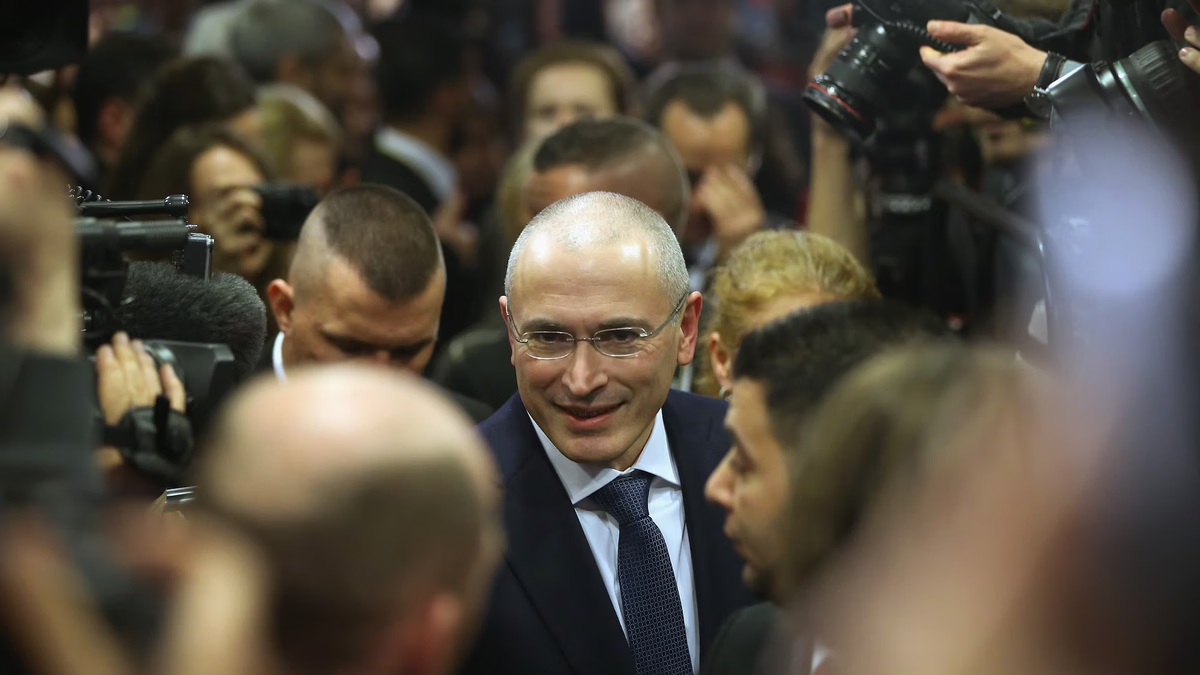
Mikhail Khodorkovsky is one of very few people who have dared tell Vladimir Putin the Kremlin’s corruption must stop. He says this conversation landed him in prison for a decade.
When Putin’s reign was in its infancy, Khodorkovsky was among Russia’s original oligarchs and the country’s richest person. Much of his fortune of many, many billions of US dollars was amassed during the chaotic dissolution of the Soviet Union, when the cash-strapped government began privatising state assets after 70-plus years of communism.
Khodorkovsky was never in Putin’s purple circle. The president considered him a threat. In 2001, Khodorkovsky founded Open Russia, a not-for-profit that advocated for democracy. While the organisation’s mission was altruistic, Khodorkovsky and others in Moscow’s corporate elite also stood to benefit financially from cleaning up Russia’s relentless graft. They were keen to access international capital markets and grow their business empires. Before that could happen, however, anti-corruption measures would need to be legislated.
In February 2003, Khodorkovsky asked Putin to help.
“I went in there and showed Putin an example of a totally corrupt transaction, in which around $400 million was stolen from the national budget,” Khodorkovsky says.
But what he did not know until a few years later was the corrupt transaction “went straight into Vladimir Putin’s pocket”.
“The president had already decided for himself that corruption would be the backbone of his regime,” Khodorkovsky told me. “Basically, if you are not corrupt, you cannot be part of his system.”
Less than a year after that conversation with Putin, Khodorkovsky was arrested on trumped-up fraud charges.
The government froze shares in his biggest company, the oil giant Yukos. Staff were harassed by authorities and much of Khodorkovsky’s wealth evaporated. The corporation’s assets were snapped up at bargain prices by the Kremlin and divided among Putin loyalists. By making an example of the country’s richest man, the president’s message was clear.
“I thought I would spend a maximum of four years in prison, since that’s how long an innocent person can be held until the court’s verdict. And then I would be released with an acquittal,” Khodorkovsky says. “The fact there would be this absolutely shameless trial, of course, I could not have predicted.”
Khodorkovsky spent almost 10 years behind bars.
In 2013 Putin granted him a surprise pardon on “humanitarian” grounds. Most experts agree the president was hoping to improve Russia’s global image as it prepared to host the Winter Olympics a couple of months later.
“Even when I was in prison, I did not consider Putin an enemy,” Khodorkovsky says. “To me he was a political opponent, albeit one who used unscrupulous methods.”
But Khodorkovsky describes the beginning of the full-scale invasion of Ukraine in 2022 as “unbearable”.
It was then, he says, “I reflected that my whole family was from there.”
“I had always perceived myself as a Russian, but after that, things switched in my head and I started thinking of [Putin] as an enemy.”
One of the informal conditions of Khodorkovsky’s release was that he leave Russia. He did that, but his advocacy for democratic change has continued. He has founded or is associated with multiple anti-Kremlin opposition networks, human rights groups, media enterprises and think tanks.
Despite having billions of dollars taken from him in the 2000s he remains wealthy, and a logical target.
Khodorkovsky knows that once upon a time, that equalled prison. Today it may mean the Russian regime’s trademark method: poison.
“I understand the risks are quite large,” he says. “But you either accept it and live your life normally, or you go and hide somewhere and hope everyone forgets about you.”
You never really know if the Russian regime will forget, Khodorkovsky says. “Putin is a gangster. He believes that if you are hiding, then you must be up to something.”
Khodorkovsky admits to sometimes wondering what his life could have been like, had he played Putin’s game.
“In a way, my family and I are grateful,” the father-of-four says. “I would have ended up like a frog in a pot of slowly boiling water, and I’m not sure I would have had the courage to jump out if I was too deep in the system.”
He reflects on how he might have acted if he was inside the Russian government as family and friends were bombed in Ukraine.
“They would have asked me, ‘How dare you?’ and I would have to try and justify it somehow. I don’t know how I would have looked them in the eye,” he says. “In a way Putin spared me from having to do that. For this, at least, I thank him.”
Entire article by Riley Stuart and Anna-Maria Tesfaye was published in ABC’s Long Read