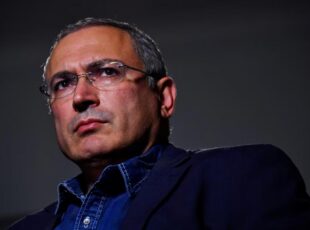
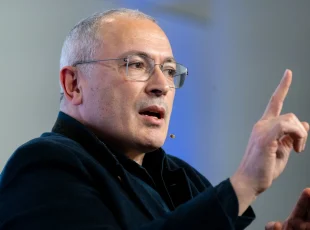
“Will Putin die in office? Very likely,” says Kremlin opponent Khodorkovsky

Kremlin critic Mikhail Khodorkovsky sees no quick end to the war in Ukraine. In his assessment, Putin’s support in Russia remains strong enough for it to continue.
A swift end to Russia’s war of aggression in Ukraine is not in sight, according to Kremlin critic Mikhail Khodorkovsky. Support for Russian President Vladimir Putin in his own country remains “strong enough” for the time being, the 63-year-old Khodorkovsky told journalists in Berlin on Thursday. This makes it all the more important that Ukraine’s supporters develop different strategies more than four and a half years after the war began.
All of Putin’s potential problems, such as the economic situation after years of sanctions, are “not critical to date,” Khodorkovsky said. There will be “no decisive” impediment to the war in the next two years – even if signs of wear and tear on infrastructure such as roads and facilities gradually become apparent, said the former head of the now-defunct oil company Yukos.
Public support for the war has also increased since Ukraine intensified its drone attacks on facilities in Russia. Polls have shown that only 35 percent of the population wants an end to the war. At the same time, however, 30 percent do not rule out the possibility that they or their relatives could be drafted into the war. It will take “at least another year” for this sentiment to shift, Khodorkovsky said. Furthermore, due to propaganda from the Russian state apparatus, citizens are convinced that they themselves would suffer losses in the event of defeat.
Khodorkovsky said that the West’s “de-escalation approach” was unfortunately “wrong” because Putin was “not a statesman of the modern world” but had been “outside the law” since his youth. He would “choose whatever escalating steps he wants.” While Putin did not currently see the use of nuclear weapons as sensible, he had no “moral or ethical qualms.”
This is because the stability of the “Putin regime” clearly depends on the continuation of the war, Khodorkovsky said. Whilst it is true that a freeze on the conflict is possible, the West could make many mistakes in such an agreement. “Will Putin die in office? Very likely,” he said of the 74-year-old Kremlin leader. At best, it might be possible to freeze the war and achieve a limited de-escalation.
Khodorkovsky did not share the fear that Kremlin chief Vladimir Putin could be succeeded in Russia by an even more radical ruler. “I don’t expect anything worse to come after him,” said the former oil magnate. “Putin will do anything to make things worse.”
According to Khodorkovsky, a democratization of Russia is “not to be expected in the next 20 years.” A more realistic approach, he said, is to hope that the parliament and the Federation Council will gain more power. The West could also try to “divide the elites.” Unfortunately, the West failed to capitalize on the initial anti-war sentiment among the Russian elites. They have since built up a safety net abroad.
Khodorkovsky was in Berlin at the invitation of the Center for Liberal Modernity for the international conference “Russia and the West.” The center’s founder, former Green Party politician Ralf Fücks, pointed out that the war in Ukraine is a “multiply asymmetric” conflict. Unfortunately, he said, Ukraine’s supporters are allowing Putin “escalation dominance because there is no clear and decisive response.”
“We are constantly on the defensive,” said Fücks. “Putin is very clear about what he wants. (…) Europe is only reacting,” Fücks complained, demanding the formulation of its own objectives. “An active and proactive policy towards Russia – that is the only language Putin understands.”
Khodorkovsky once owned Yukos, Russia’s largest oil company. It was founded in the early 1990s when oligarchs like him acquired former Soviet state assets at bargain prices. Khodorkovsky later emerged as a vocal critic of Putin, was arrested in 2003, and spent ten years in prison. Since his release, he has lived in exile and founded several opposition movements against Putin.
Originally published in German in WELT