Putin’s critic Khodorkovsky “Almost the entire Russian elite is against war.”
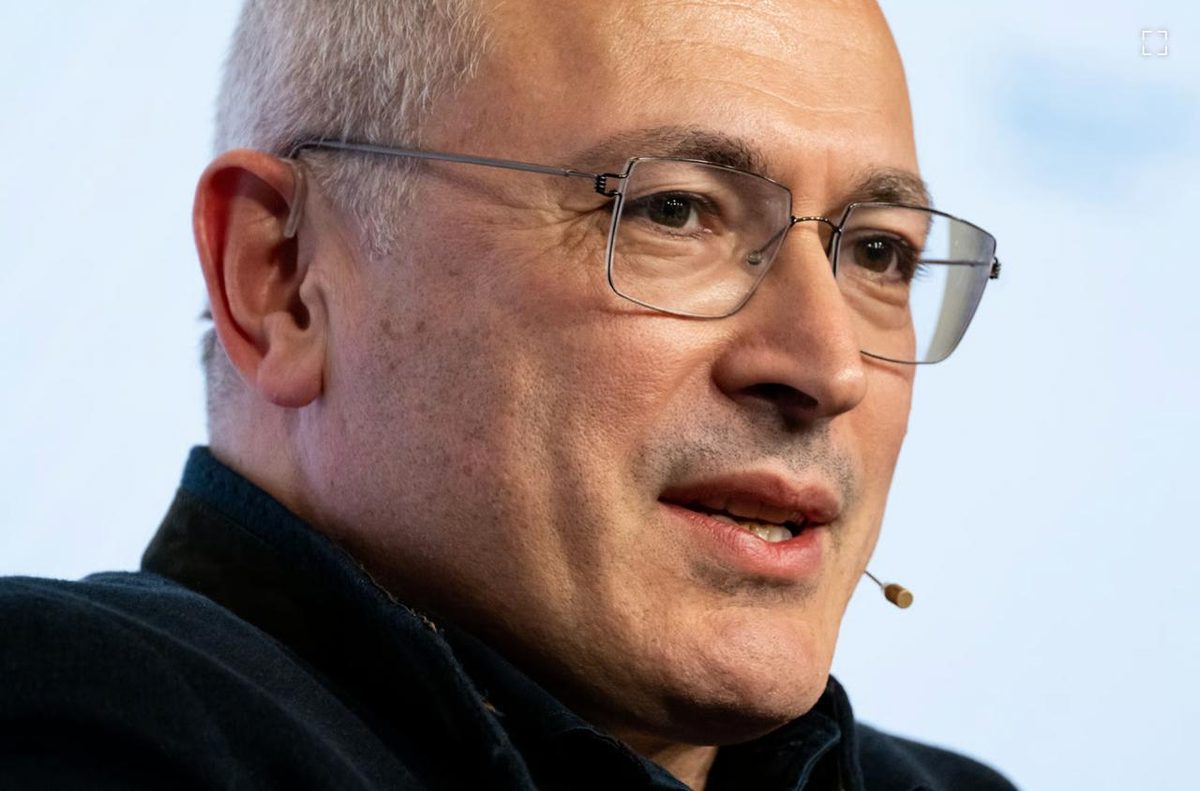
Putin critic Khodorkovsky: The West is subject to a “thinking error.” Photograph: Sven Hoppe/dpa
Mikhail Khodorkovsky explains what the Russian parliamentary election betrays, how he assesses Putin’s mental state and what is the “fundamental mistake of thinking” of the West for him.
Mikhail Khodorkovsky has lived in exile in London for years, but remains one of the best-known critics of Russian President Vladimir Putin. Ahead of the upcoming Duma election from 18 to 20. September, he spoke to Handelsblatt about Russia’s war in Ukraine and Putin’s calculus toward the West.
Khodorkovsky does not expect an economic collapse of Russia. “As long as China continues to supply Russia, the situation can deteriorate endlessly and Putin can still continue the war,” he says. From his point of view, the Russian president is waiting until the Europeans give up their support for Kyiv. The West makes the “basic mistake” to believe that Putin is looking for a way out of the war.
Read the full interview here:
Mr. Khodorkovsky, after the Russian raid on Ukraine, you said it was of the utmost importance for Putin to turn his war into the war of all Russians. Did he do that?
For a long time, Putin has tried to wage war as a special military operation. The mobilization in 2022 has shown that Russian society is unwilling to understand this war as something personal. From history, we also know that the Russians tolerate an unsuccessful war for no more than two years. Putin has done everything he can to avoid setting the stopwatch in motion. But since the Ukrainian attacks on Russian oil refineries and warehouses this year, the countdown has been on.
What happens if the war still lasts in late 2027?
Approval of the war has risen as a result of the Ukrainian attacks, by seven percentage points since February. Putin’s personal approval ratings have collapsed. In the past, both values would have risen together, now they are developing in opposite directions. If military activity continues after 2027, Putin’s approval ratings would decline even more significantly.
Would that eventually persuade Putin to end the war?
Currently, he seems willing to pay a high political price. However, the declining approval ratings shift the center of power to the security forces that keep society under control. Of course, a rule can be backed by the military, but that’s uncomfortable for Putin. It’s a question for the psychologists how long he’s still wanting to pay that price.
Putin has reportedly said internally that he will be hanged if he loses the war. Who does he fear?
Almost the entire Russian elite is against the war. But as long as there is no dramatic defeat on the battlefield, the president does not have to fear this elite too much.
How meaningful is the general election? Will something read on the result?
The mood can be interpreted even before the election. Take, for example, the anti-war party Jabloko. She was initially allowed to run for the election because she was only expected to have one to two percent of the vote. But then their approval ratings shot so high within two weeks that the Kremlin got real fear. According to our calculations, Jabloko was suddenly at ten percent and could have even risen further to 20 or 25 percent. These were mainly protest voters.
How did Putin react?
For a democratic society, 25 percent of protest voters are not a critical mass. But for a dictatorship, that’s a very strong signal, and one was afraid that this would become public. That’s why Jabloko is now not allowed to run in the election.
Does the Russian opposition, with its anti-war positions, reach the ordinary Russians at all?
At the moment we can appreciate this on the basis of our channels on social media. If we take together all opposition media offerings, we get to a reach of about ten million people a day. In an extreme situation, such as the uprising of the Wagner Group, this rises to up to 30 million. That always happens when people realize that change is possible and that this change depends on them.
So there’s a significant anti-war camp?
We estimate the anti-war opposition at about 15 percent of the population. In addition, there are the “Z” or turbo-patriots, the opposition from the other side. They also make up about 15 percent. The remaining 70 percent are politically inactive and make their decision from the moment.
International observers expect mobilization after the election. What do you expect?
I’m absolutely sure Putin needs a mobilization. However, it does not have to be announced, but will simply take place. To allow a rotation alone, Putin would need 300,000 additional troops. Because of the higher demands of warfare, he doesn’t just need someone, but educated people. In my estimation, half would have to be students and engineers.
That would probably hit the middle class in the bigger cities. Could their protests speed up the end of the war?
If he were pragmatic, Putin would have to stop the war as soon as possible. But when you look at his psychological state … I have the impression that many of his decisions have not been based on pragmatism lately.
What should or can the West do if it is dealing with a not particularly rational person? Also with a view to all the drone strikes and acts of sabotage?
When we get into Putin, he thinks that Ukraine is tired. The West too. In Germany there will be a change of government, if not today, then tomorrow. And the new government will stop supporting Ukraine. The same will happen in France next year. So I just have to last a little longer, Putin thinks, and then everything will be fine. Every time the EU discusses a new aid package for Ukraine, it struggles only to make a decision. And maybe she won’t make a decision tomorrow. So I, Putin, have to remain steadfast.
Europeans are the weak point?
Europe would have to find the strength to actually show Putin what it always says. We will support Ukraine for as long as it is necessary. We have decided on the rearmament plans and we will implement them. And according to these plans, we will produce more weapons in two years than Russia. In this case, Putin’s psychological state would look completely different.
What would he think?
My God, I have to end this war as soon as possible. Otherwise, it’s my end. Unfortunately, Europe has not yet shown this internal firmness to Putin. Instead, the impression emerges that it could stop the aid tomorrow.
In response to the act of sabotage in Leipzig, Germany closed the Russian consulate in Bonn, closed the Russian House in Berlin, announced sharper border controls for Russians and also significantly reduced the number of tourist visas. Isn’t that determined enough?
Experience shows that sabotage is not really related to the number of visas issued to Russians. Many people involved in sabotage have Western passports, some were even born in the West. Of course, such measures also have a symbolic significance. If you reduce the number of Russian employees in diplomatic missions, this also reduces the possibilities of the Russian intelligence services. I’m not sure that’s the best way.
Can the Europeans alone build up a threatening backdrop, or do the Americans have to be on board?
Did you notice that I didn’t mention the Americans? Because that’s exactly how it looks in Putin’s head: There are no Americans out there. He thinks, “I will always find a common language with Trump.” If Trump were to change his position, the entire picture we just talked about would immediately change.
Putin does not appear to be able to achieve his military goals, but has no exit strategy. How could he end the war without admitting his failure?
They assume he’s looking for an exit. But it’s very likely that he’s not looking for one at all. That’s the fundamental error of thought in the West. Putin’s position is: “You Europeans will stop supporting Ukraine in six months. You Americans will not use violence against me. I’ll talk to you politely. I don’t want a fight. But I will continue to do what I want. And who are you anyway?”
Do Russia’s strategic partners have any leverage? India’s Prime Minister Modi recently said it was time to end the war. Kazakhstan’s President Tokayev was surprisingly critical. Why do they suddenly dare?
A lot does not mean these words. Maybe they explained this publicly and went to Putin afterwards and said, “Well, we have to say something to Washington.” And Putin replied, “All right, you continue to buy my oil and supply us with goods.”
Doesn’t the criticism show that Russia is losing its influence?
It’s a painful loss of reputation for Putin in the circle he’s moving in. But my impression is that strategic perspectives don’t really interest him at the moment. He is totally fixated on winning this war. Have you noticed that he is learning the names of these small Ukrainian villages? But he doesn’t bother knowing the Kazakh president’s patronage. This would be much more important than remembering the name “Mala Tokmachka”.
Could the Russian economic crisis force Putin to end the war?
Current revenues from trade, including oil and gas, are enough to buy the necessary goods in China. The second component is the redistribution within the economy: production capacities and human resources are geared to the military needs. This means that the infrastructure is not maintained or modernized. Barges sink, pipelines explode, the heating fails in the winter, in some areas five-storey buildings collapse. That’s increasing, but won’t be critical in the next two years.
So Putin won’t run out of money?
The only economic factor that could put an end to the war would be the absence of supplies from China. As long as China continues to supply Russia, the situation can deteriorate endlessly and Putin can still continue the war.
The interview by by Vera Fromm, Carsten Volkery was first published in German in the Handelsblatt